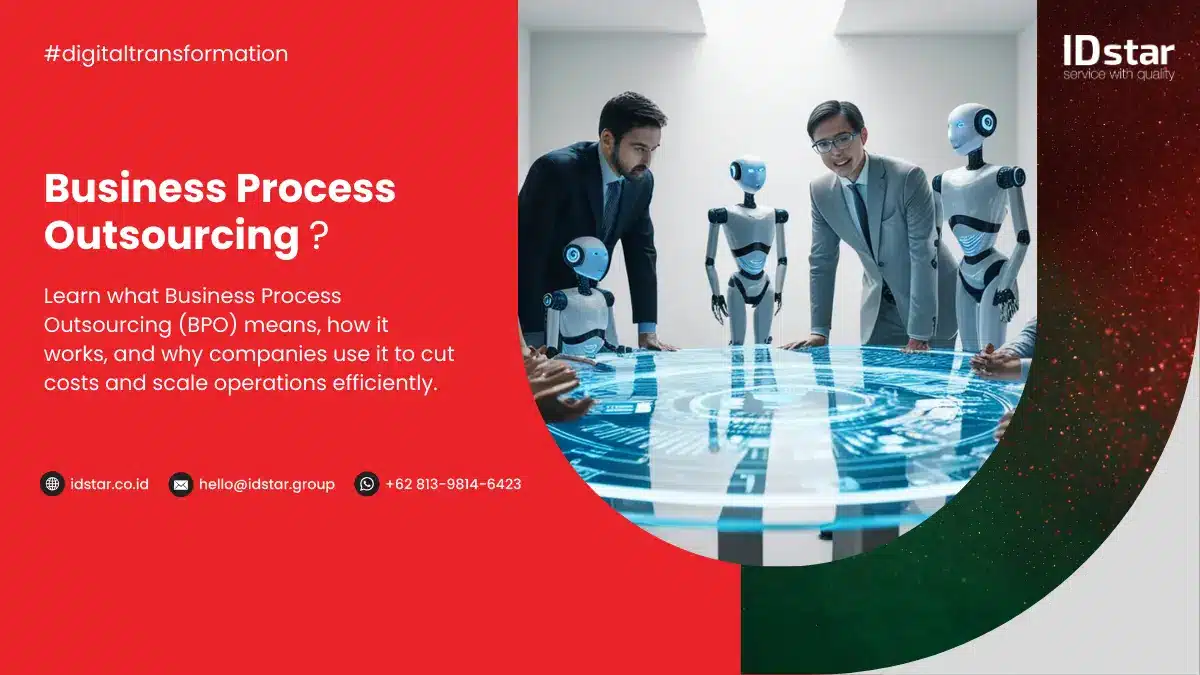
Business Process Outsourcing (BPO) is no longer just a strategy for large enterprises. Today, businesses of all sizes—from SMEs to fast-growing startups—use outsourcing to streamline operations, reduce costs, and access specialized skills they don’t have in-house.
However, many people still misunderstand what BPO truly means, how it works, and why companies use it. This guide explains BPO in simple, practical terms so business leaders can understand how it fits into modern operations.
What Business Process Outsourcing Really Means
Before we explore how BPO works, it’s important to clarify what the term actually refers to. Business Process Outsourcing happens when a company delegates certain tasks or processes to an external specialist instead of handling everything internally.
These tasks are usually repetitive, operational, or require skills that are expensive to hire full-time. By outsourcing, companies gain efficiency without increasing internal workload.
Read: What Is IT Outsourcing in Singapore? Benefits, Trends, and Examples
How BPO Works in Real Business Operations
Now that we understand the meaning, the next question is: how does BPO actually work inside a company?
BPO providers usually handle specific functions end-to-end, using trained teams, proven workflows, and—more recently—automation and digital tools.
Businesses simply connect their processes, set clear requirements, and the provider manages the execution on their behalf.
Here’s how it typically operates in practice:
-
The company identifies a process that takes too much time or cost internally
-
A BPO partner provides the team, tools, and process workflow
-
The business receives completed work, reports, or processed data
-
Costs are usually billed per task, per process, or per month
This model allows companies to stay focused on core business while specialists handle the rest efficiently.
Read: Why SMEs Struggle to Digitalize in Singapore?
Common Types of BPO Services
Understanding the different categories of BPO helps businesses choose solutions that match their needs. Below are the most commonly outsourced functions, each solving different operational challenges.
Customer Operations Outsourcing
This includes customer service, call center operations, live chat, and email support.
Businesses outsource this to provide faster response times and better coverage without hiring large teams.
Finance & Accounting Outsourcing
Largely used by SMEs and enterprise finance teams, including:
-
Accounts payable
-
Accounts receivable
-
Expense verification
-
Invoice processing
-
Payroll administration
This reduces human error and ensures compliance.
Human Resources Outsourcing
Covers tasks like recruitment support, onboarding, HR documentation, and employee data management — especially useful for companies with small HR teams.
IT & Technical Support Outsourcing
This is one of the fastest-growing segments, covering:
-
Helpdesk support
-
System monitoring
-
Infrastructure management
-
Automation and workflow support
Companies use this to fill skill gaps and reduce tech-related downtime.
Read: How to Choose the Right IT Outsourcing Partner in Singapore
Why Companies Use BPO Today
Each organization has its own reasons for outsourcing, but the benefits tend to follow similar themes.
Before we discuss them individually, it’s useful to understand that BPO is not just about cost-saving—it’s also about scaling faster and operating more intelligently.
Reducing Costs Without Lowering Quality
Instead of hiring full teams internally, companies can access trained specialists at predictable monthly costs. This helps businesses operate efficiently even with budget constraints.
Access to Expertise and Better Tools
BPO providers use established workflows, automation tools, and experienced teams. This gives companies immediate access to capabilities they don’t have internally.
Faster Operations and Higher Productivity
By offloading repetitive work, employees can focus on strategy, innovation, and customer experience instead of manual tasks.
Supporting Growth and Scaling
During expansion—new markets, new customers, new product lines—BPO makes it easier to grow without restructuring teams or adding heavy overhead.
Is BPO the Same as Automation?
Not exactly, but they now often work together. Modern BPO providers combine human expertise with digital workers, automation, and AI-driven workflows — making processes even faster and more reliable.
This blend is especially effective in finance, HR, and customer operations, where repetitive tasks can be automated while humans handle exceptions or complex cases.
Who Should Consider Using BPO?
Any business facing one or more of these challenges may benefit from outsourcing:
-
Too much manual work consuming team capacity
-
Difficulty hiring specialized roles
-
Rising operational costs
-
Slow turnaround times
-
Business functions that are non-core
-
Sudden growth requiring scalable operations
Startups, SMEs, and enterprise teams all use BPO depending on their growth stage and pain points.
The Future of BPO: Digital, Automated, and Integrated
BPO is evolving from traditional manual outsourcing into a more advanced model powered by automation, AI, and workflow intelligence.
Companies increasingly expect more than manpower—they want process optimization, speed, accuracy, and measurable impact.
This shift means the future of BPO is not just outsourcing… It’s outsourcing combined with digital workers, giving businesses access to scalable and highly efficient operations.
Ready to Transform Your Business Operations?
If your team is spending too much time on repetitive work, or you need a more efficient way to manage operations, BPO can help you reduce costs and improve speed.
IDstar supports businesses with process outsourcing powered by automation, digital workers, and expert teams — helping you scale without complexity.
Digital Transformation? #IDstarinAja